
A fulfilled-gospel response to the panic over the US/Iran Conflict
Let me be clear. The effects of the US/Iran conflict would be far-reaching and global. But it would not trigger what many Christians have been anticipating for centuries – the end of the world. Not any more than World War 1 or 2 led to the end of the world.
But…
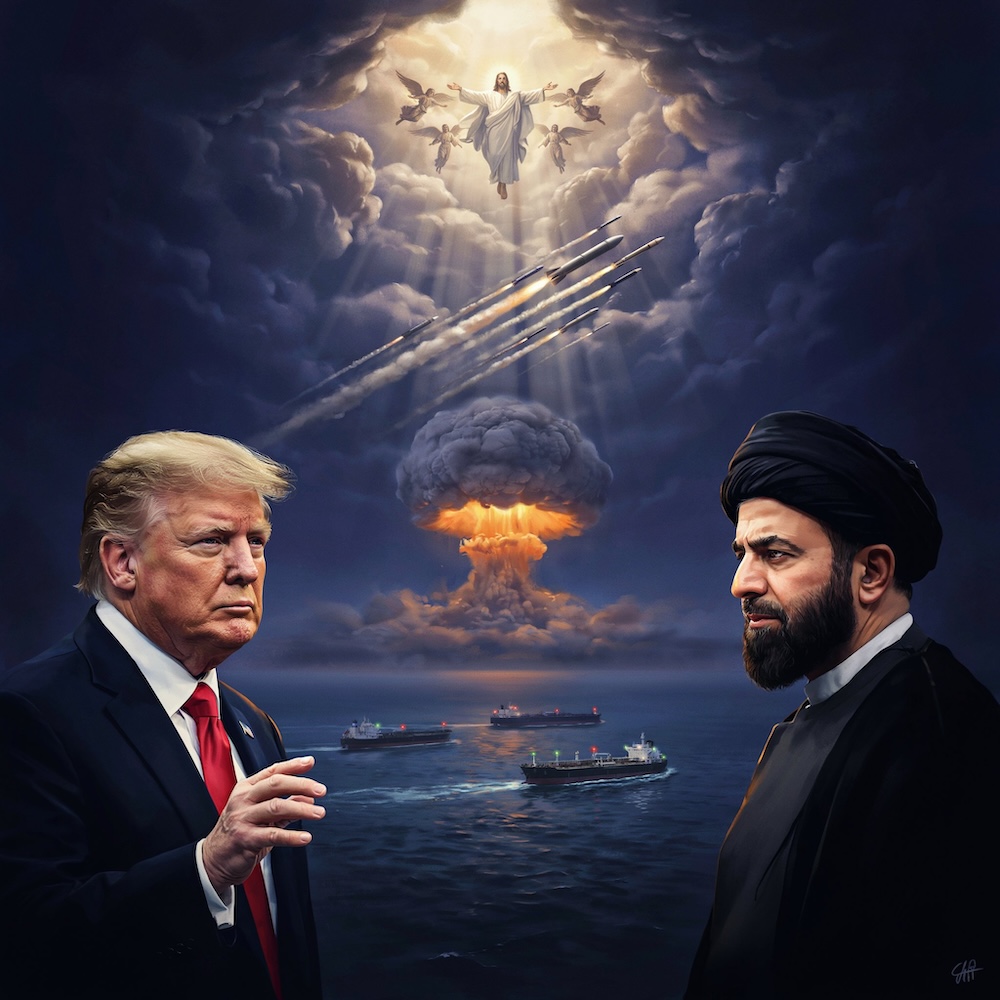
A few weeks ago, the US was bombing the “hell” out of Iran, Trump was threatening to wipe a civilisation off the map, and the prophecy voices went into overdrive. A prominent pastor was predicting that the next event is the rapture, and once that happens, here comes the Antichrist, the tribulation, Armageddon, the works. He admitted it was frightening. Millions felt that familiar tightening in the chest.
“Surely, this time, the rapture is days away”
The pastor laid his end-time dominoes out in public: the next event on the prophetic calendar is the rapture of the church, and once that first domino falls, the rest would follow: the emergence of the Antichrist, the tribulation, the battle of Armageddon, the second coming, the millennial reign, with the Magog-and-Persia invasion of Ezekiel 38 somewhere in the mix. Prophecy websites ran Rapture 2026 countdowns. Across our timelines, a familiar sentence spread like a brushfire: surely, this time, the rapture is days away.
But look at the direction things are now moving. Instead of the region tipping into the final war, the United States has recognised that Iran is a tougher nut to crack than they expected. Iran is using its military strength to negotiate a final agreement, with a sixty-day window, talk of reopening the Strait of Hormuz, and even $3bn for reconstruction. A ceasefire is being pieced together. It is fragile, it may or may not hold, and the strikes have not fully stopped, and Israel is not happy.
War on this scale has become too costly
But the gravitational pull is unmistakably toward the table, not Armageddon. And that is the pattern, every time. Modern nations, for all their threats, keep reaching for peace, because war on this scale has become too costly — not only to the enemy, but to the whole interconnected world. The “Armageddon trigger” keeps turning into a negotiation.
If you have been a Christian for any length of time, you know this pattern in your bones. That tightening in the chest, the strange cocktail of dread and hope — and then the quiet dissolve into a news cycle. We have felt it before: the Russia vs Ukraine, World War 1, World War 2. All these conflicts were supposed to trigger the ‘end.’ And every single time, the world came to its senses, and we were still here.
The problem was never that the world stubbornly refused to end on schedule. The problem is that we were given a framework that has us scanning the news for an escape hatch instead of doing the work that is right in front of us.
Bringing us up to speed
Here is the premise I am working from, and I am not going to spend this whole article re-arguing it, because it is the settled foundation of everything else: the entire Bible has already been fulfilled by Christ and in Christ. Not most of it. Not the comfortable parts. All of it.
Jesus said so himself, in his own words, after the resurrection: “Everything written about me in the Law of Moses and the Prophets and the Psalms must be fulfilled” (Luke 24:44). The whole Hebrew canon – the Law, Prophets, Writings, all pointed to him. He came to promise its fulfilment, and he returned in fulfilment of his promise. He was, as John put it, the Word made flesh, the True Light arriving in Israel’s darkness exactly as Isaiah had foretold.
That fulfilment includes the parts our generation has been trained to push into the future. The ‘rapture’. The coming of the Lord. The resurrection. The gathering. The passing of the old heavens and earth. Jesus told the generation standing in front of him that they would see it: “this generation will certainly not pass away until all these things have happened” (Matthew 24:34). The apostles preached the same nearness — “in a very little while,” and he “would not delay” (Hebrews 10:37). And it came in AD70, in the events that closed the old covenant world in that first-century generation.
Christ is reigning, Christ is king.
We are living after the end – after the end of that old world in which Jesus, the apostles, and the ancient peoples lived. We are now in the endless age of the Kingdom of Heaven. Christ is reigning, Christ is king.
If that is new to you, or it unsettles you, that is alright. I was unsettled too. I have laid out the full scriptural case elsewhere, and the most in-depth version is in my books ‘Why Christ Has Already Come Back’ and ‘Everything Is Temple’. For now, take it as the ground we stand on, and let me get to the part that actually matters.
The rapture already happened
The US/Iran conflict panic runs on one specific brick, the first domino in the whole chain: the belief that the rapture is still ahead of us. The church will be snatched away, and then everything else cascading after. It was domino number one in the end-time prophecy lineup. But, remove that brick, and the entire anxious structure has nothing to stand on.
Are we willing to read Paul’s actual rapture text and do the one thing almost nobody does? Check who he was talking to. “We who are alive, who are left, will be caught up together with them in the clouds to meet the Lord in the air” (1 Thessalonians 4:17). We. Paul places himself inside that group. A few lines earlier, he told the Thessalonians that they were waiting for God’s Son from heaven (1:10), and that the living among them would be caught up. Not a generation two thousand years down the road; rather, the people holding Paul’s letter in their hands.
The rapture belonged to the first-century generation
And Jesus said fundamentally the same about his own coming. “This generation will certainly not pass away until all these things have happened” (Matthew 24:34). Not a generation, somewhere off in the distant future. But, this generation – the generation he was sent to, the generation that ate and drank with him, that climbed the mount to hear him, that he fed with loaves and fishes. Read in its plain historical setting, the language is not vague. It is specific.
So the rapture was never a date on our twenty-first-century calendar that keeps failing to arrive. It belonged to that first-century generation, fulfilled in the events that closed the old covenant world. It was fulfilled exactly when, and exactly where, the New Testament said it would be. The thing the modern church has braced for across two thousand years already came. There is no evacuation pending in the wings of an Iran war. And once we see that, the natural next question is the only one that matters. That question is: What are we here for?
Enjoying this post?
Support this Ministry –>
What the fear costs, and what replaces it
It is a fair question, and the honest answer exposes what the old framework quietly did to us. Futurism breeds passivity. If the world is a sinking ship and rescue is imminent, why bother bailing? Why invest in anything that lasts? Many sincere believers spend their lives in cycles of anxiety and disappointment, treating every disaster and every war as a sign, praying for God to come in fire and burn up the wicked, waiting to be removed.
Fulfilment, on the other hand, breeds builders. Once we see that Christ has already fulfilled his promises on time, the whole posture changes. There is no escape coming, and there is no “end” left to escape. Paul gave “glory to God in the church throughout all ages, world without end” (Ephesians 3:21). We are living in the age that does not end. That is not bad news. It is the doorway to our actual calling.
So here is the reframe, and it is the heart of everything I want to put before us: the things we have been taught are unfixable until Christ returns, are actually addressable right now, because Christ has already come. The division, the decay, the brokenness, the fear itself – these are not conditions we are merely sentenced to survive until an airlift arrives. They are exactly the territory a fulfilled people are equipped to change.
How the fulfilled Gospel meets a world at war
Practically, for a time like this one, that looks like a few concrete things.
First, we refuse to be the people whose theology secretly wants the worst. There is something revealing in how a ceasefire and a turn toward negotiation land as a kind of letdown in prophecy circles, almost as if peace breaking out has spoiled the timeline. We have no part in that. A people who needs the body count to keep rising in order to feel that God is moving has badly lost the plot. We are called to be peacemakers and agents of healing, administering the leaves of the tree of life for the nations, not praying down fire.
Stop doom-scrolling for signs and start doing the unglamorous kingdom work
Second, we stop doom-scrolling for signs and start doing the unglamorous kingdom work. We raise children who are not paralysed by fear of the Mark and the Beast. We build families, businesses, and institutions meant to last, not abandoned as deck chairs on a doomed ship. We bring the good news into the real arenas of influence – finance, education, politics, and faith – because once people are transformed, those arenas are transformed, and once the arenas change, the world changes.
Third, overcoming is contemporary and personal: no trial will come that we are not given the strength to bear (1 Corinthians 10:13), and the one who overcomes inherits and is seated with Christ himself (Revelation 21:7; 3:21). The change we are called to make is generational and global: the kingdom is a stone cut without human hands that fills the whole earth and never ends (Daniel 2:44), and we shine as lights in the middle of a crooked generation (Philippians 2:15; Matthew 5:16). We overcome today. The change we begin is for generations we will never meet.
This is not a sinking ship. All ungodly ways are doomed to fail on their own. Only what is built on the teachings of Jesus endures the storms. God’s nature is to act, not to react, and his people are meant to be the initiators of change, not the victims of circumstance. Let us choose to initiate, not retaliate.
The open door
So watch the news this week, but watch it differently. The US/Iran conflict is not a countdown to our removal. It is a backdrop against which a settled, unshaken people can do the work of the kingdom.
The door is already open, and no one can shut it. But it is not an escape hatch; it is a commission. We are not the exodus generation staring at the wilderness, waiting to be carried somewhere safe. Their hope is our reality. We are in the promised land, and there is a world to build.
Let us stop bracing for the end, and start overcoming in the age without end.